Showing posts with label CRPG. Show all posts

Monday, 24 September 2012

Crimson Twilight Preview (Commodore 64, 2012)


I know this now really archeo, but while I'm finishing my researches on Dragon's Eye I just want to to suggest you to have a  look at an interesting release which might see the light by the end of year. It looks like is going to be a top view CRPG Ultima style for C64 and as far as I could see from the preview it looks very promising. 


Here you can download the playable preview.

Edit: Screenshots have been updated from the previous post. Now you can actually see how the project is progressing even from a design point view.

Tuesday, 14 August 2012

Maze Master (1983, Commodore 64): a case of unimaginative artwork.

Maze Master is an archetypical dungeon crawling CRPG published for the Commodore 64 in the 1983 by HesWare. Aside from its historical relevancy, Maze Master is also known for being the Bards' Tale predecessor since its creator Michael Cranford produced the first chapter of the successful Bard's Tale Saga in 1986. 

Anyway, one of aspects that grabbed my attention is more related about its own aesthetics rather than the game itself. Even if the overall visual aspect of the artwork adopted by HesWare has some interesting elements, Maze Master is the classic example of a fantasy CRPG artwork developed by a company without a proper RPG/CRPG background. 

Maze Master, Front Box Cover
The cover itself has some archetypical fantasy elements which are mainly condensed in the full colour illustration representing, in a dungeon environment, a giant snake in the attempt to attack a warrior and wizard. Moving away from the illustration, the two elements that deprive the artwork from being more fantasy oriented, are the fonts (1) used on the heading and product descriptor and rainbow gradient used on the top part. However, looking at other Hesware releases, it's easy to note that for consistency reasons, they usually applied the same template to all their production and so they did with this one.

From a visual point of view, anyway, what is really inappropriate is the clinical layout which doesn't show any connection whatsoever with the game genre and concept. 

Maze Master, Cover Manual
A linear grid with a green background, although it's typographically clean and balanced, looks like more a utility software manual than an actual CRPG. 

Maze Master, Manual, p 5

Maze Master, Manual, p 7
The two pages above are just part of the manual which actually doesn't contain any illustration, any additional tint or symbol. Only text, black on white. 

Compared to other productions published in the early eighties, Maze Master looks visually much more professional than products like the Aardvark's Dungeons of Death and Dungeons of Magdarr. But because I really believe that the visual aspect of a CRPG represents a big part of the game impact and honestly Maze Master really lacks of what I call "imaginative visual impact", which is first experience you have with a CRPG. Maze Master is exactly in a visual limbo, between top class Epyx & Origin products and the primitive and fascinating underground productions. 

In the end, MM is a quite interesting and advanced game that probably never got that popular due to the strong Epyx and Origin presence on the markets. A game like that, with such a weak artwork, lack of visual inspiration and a so limited distribution (produced only for C64 actually) had probably to struggle to get a bit of attention from its potential target.


---
(1)  Arial rounded and Helvetica. 

Thursday, 9 August 2012

Wishlist: Write your own Fantasy Games for your Microcomputer (1984, Usborne)


This is definitely something I would love to have. Unfortunately I never had the chance to see the actual book and now I'm really determined to see this little gem with all the rest of my personal collection. Wish me good luck.

Wednesday, 8 August 2012

Sorcerer of Siva (Apple II, 1981), III: The Magic System.


On Monday morning I had a little bit more time to play Sorcerer of Siva and get a bit more used to the Magic System. If you are wondering why I'm dedicating one full post to a CRPG Magic System, the answer is because I believe that every single fantasy CRPG has to consider a magic system no matter its complexity.

The Sorcerer of Siva, due its sorcerer vs sorcerer nature, has an interesting magic system considering its  old age and simplicity. Unfortunately some of its peculiarities, in my opinion, tend to make game to hard to play.

Apart from my personal considerations, we can roughly say that Sorcerer of Siva has a magic points system, which traditionally it's the most common for non-D&D and AD&D based games.

Your value magic points derive directly from your level of Aura, which is the emanation of your mental and magical power:
Your aura is a measure of the mental or mystical energy needed to cast a spell. Performing any magical act temporarily depletes or weakens your aura (that is, shifts it toward the red end of the spectrum), although some spells cause it to fade more than others. Although the computer keeps precise track of your mystical energy, AURA will be displayed as one of only six colors: BLUE (best), GREEN, YELLOW, ORANGE, RED, or BLACK. (On some computers, this state will be represented by a printed word on the side of the screen; on others, the color change will show up on the figure itself.) An ORANGE or, especially, RED AURA may prevent you from casting any of the more difficult spells, and if your AURA is BLACK, you will be unable to cast spells of any kind. Unless you are EXHAUSTED, doing anything except casting spells will strengthen or refresh your aura (shift it back toward the blue end of the spectrum). The less physically tired you are, the faster your aura will be enhanced.
Source: Sorcerer of Siva, Manual, p 17

A fair amount of Aura will allow you to cast spells during the game and even if the list is limited to seven only, a wise use of them will probably establish your victory over the maze master*. 

Here's the list of available castings:
Teleportation (most powerful)
Bolt of Lightning
Jumping
Locating a Staircase
Fireball
Healing
Opening Sealed Doors (less powerful)

Casting a Lighting Bolt will cost you a nonspecific cost of Aura.

Each spell has a nonspecific cost which it's detracted from your Aura. The lack of statistics about the magic point costs makes the management of your magic reservoirs quite chaotic. Another interesting aspect is that even if the system is not based on Vancian Magic, spells are in some way forgettable.
Regardless of your aura, you can't cast a spell you have forgotten. This unfortunate circumstance can come about in either of two ways. Whenever the sorcerer appears on the screen, he may cast a spell of forgetfulness, causing you to forget the most powerful spell you have left. Also, the higher the skill level you select at the beginning of the game, the
more spells you have forgotten and the fewer spells you have available initially. (This is presumed to be the result of previous attacks by the sorcerer.)
Source: Sorcerer of Siva, Manual, p 18 

Spells might be forgotten so, but if are your lucky to find one of the touchstones inside the mines, you can regain what is "lost":
The only way to remember spells you have forgotten (including those you lacked at the beginning of the game, if any) is to find touchstones inside the mines.  Whenever you find a touchstone, you will recall one spell—the lowest-numbered spell you don't know. If you knew (remembered) five spells, a touchstone would bring to mind Spell #6 (Bolt of Lightning). 
Source: Sorcerer of Siva, Manual, p 18 


Again, here:
If you find a touchstone, it will immediately release a mystical energy that will break the mental block caused by the sorcerer's spell of forgetting. That is, the touchstone will immediately restore to you the lowest-numbered spell you have forgotten. 
Source: Sorcerer of Siva, Manual, p 21 

It's interesting to see the choice of words of this last part of the manual where a mental block substitutes the actual memory loss mentioned before. According to this part, your character doesn't really forget the spell, he is not just able to use it because the magical mental block. It's a detail I know, but they all together build up the flavour of every single aspect of a CRPG.

In the end, this magic system is quite simple and easy to use and it suits with the game concept. However the frustration grows when you realize that the level of your Aura goes down really quickly due to the high frequency of the encounters. Thus after few minutes you can find yourself completely drained and unable to cast any spell and, trust me, it is really frustrating.

The high difficult level reminded me the earlier tendency to create really challenging and complicated CRPGs because the main marketing target was intended be the small and demanding niche of computer academics, wargamers and role playing gamers. In this case, anyway, we can't really talk about a complex system, but an excess of difficulty in the gameplay.

*If there is anyone around who managed to finish the game, please contact me.

Tuesday, 31 July 2012

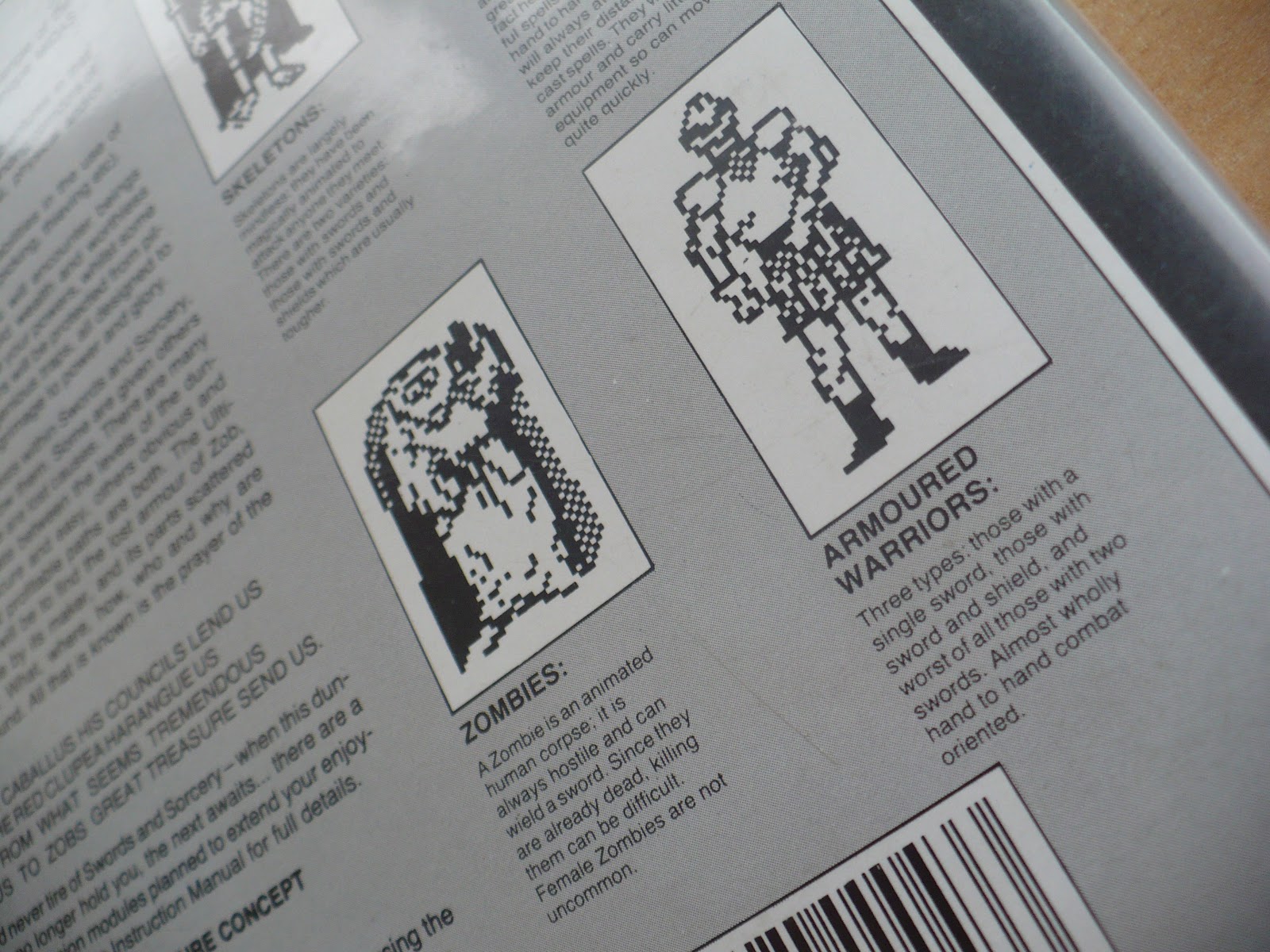
Archeoshot #004: Swords and Sorcery (Spectrum 48k, 1985)

Front Box

Front Box, Bottom close up

Front Box, Top close up

Back Side


Back Side, Close up

Back Side, Top close up

Spine

Manual

Cover Manual, Close up

Back Manual, Close up

Tape, Spectrum 48k version

Sunday, 29 July 2012

Sorcerer of Siva (Apple II, 1981), II: First gameplay.

Thanks to Robinson Mason I have finally managed to put my hands on a working copy of Sorcerer of Siva and just this morning, I tried to get familiar with all the commands (quite similar to all the rest of Dunjonquest series) and the game system itself.

As I have promised in the previous post, here's a part of my first thoughts after a first approach with the game. I managed to include even some screenshot and hopefully I will be able to create soon a video of an actual gaming session .


Sorcerer of Siva, desktop screenshot of a first gaming session

The first thing I have noticed, after two hours of testing and playing, is that Sorcerer of Siva is quite hard. The probability to die is really high and even if you are equipped with quite powerful spells, your character gets tired and unable to cast, move or attack after few minutes. In some way, it reminded me the frustration of playing (and dying) in Rogue.

Epyx Welcome Screen
Main Screen

The main screen is quite essential: game title, credits and date of release. You just need to hit a key to get into the game. 

Skill Level and Speed Factor menu

Just before the game starts, you can choose the general skill level and speed factor. I initially decided for an average value of Skill 5 and Speed 5, just thinking that it was ideal for a quick testing. Pure naivety. 

And here you are into the Caves of Siva

Above a first screenshot of the actual game. As expected, the game is visually really basic and structured on simple but solid monocromatic bidimensional layout: main game on the left side and statistics on the right. The movement system can result a bit difficult if you are not familiar with the Dunjonquest series. Anyway, as for almost all the early CRPGs the manual with all the instructions is vital and specifically for this one, no manual means any chance to survive at all. Intriguing. 

In Sorcerer of Siva there's no trace of any character creation, once you have chosen your difficulty level, the game starts immediately and as said in the previous post you wear the shoes of a sorcerer capable of either combat with various weapons and cast spells. Sadly you can't choose your equipment, spells or weapons to use and apparently the only way to change your initial status is to find more treasures and equipment during the exploration of the Caves and Underworld. 

However all you need is on the right side of the screen where you can find vital signs, magic aura level, time and location statistics. 

Apart from the Magic System, which will be analyzed in the next days, you need to get used with the vital signs control of your Sorcerer. 

Energy & Fatigue
Casting spells, fighting, and running about in the mines naturally make you tired. While the computer keeps precise track of exactly how much physical energy you have from moment to moment, the display shows only five basic states of fatigue: FRESH, TIRING, TIRED, WEARY, or EXHAUSTED. The fresher you are, the faster you strengthen your magical aura (that is, the faster you recover the mental/mystical energy expended in casting spells). When you are EXHAUSTED, you cannot increase your aura rating, and you cannot perform physical activities such as moving or fighting.
You can recover from fatigue in either of two ways. The first is the simplest and slowest: just rest by typing 0 (zero)—that is, moving zero feet—or do something else requiring no energy (e.g., the S or E commands). Although the computer will make the appropriate adjustments each time you rest, you may have to do this several times before you notice a change in the printed display. (After all, you can't go from being EXHAUSTED to being FRESH simply by pausing for a few seconds of rest.)
You can regain physical energy much faster by using the energy spell (N), but this, of course, will drain you of some of the mental energy shown under AURA.
Source: Sorcerer of Siva, Instructions Manual, p 17 

It's essential to learn how to manage your fatigue otherwise you will just face a certain death after few encounters. The management of your health affects everything and it's a big complication while wandering monsters attack you almost every step.  

Trapdoor and Wyrm 

Above  you can  see vivid example of what can happen during a quick game session. After few minutes and three encounters,  I fell in to a trapdoor and just right there a Wyrm was ready to attack and eventually kill me.

Scoring Screen

This screenshot  reports my personal record: 9 minutes of resistance. Apart from my lack of skills, the scoring screen gives the sense of how much you progressed in the game and how you managed all your magical and vital resources.  
When you finish your game, you will be given a score that takes in many factors: the speed and skill level you selected, the treasures you accumulated, the state of your health and aura, and so on. Two considerations, however, are of overriding importance: Did you find your way out of the mine, or did you get killed? And did you slay the sorcerer?
Don't expect to get all the way through the mine on your first try, even if the skill level and speed factors are set to 1. As you gradually learn the secrets of the mine and its treasures, you can keep the game challenging by adjusting the skill level and speed factor appropriately. This will also increase your possible score, but you will find it more difficult to do as well with the added handicap. If you can triumph on Skill Level 8 and Speed Factor 10, you are a wizard.
Source: Sorcerer of Siva, Instructions Manual, p 16


In the next days I will have a better look at the magical system which is with the vital/health system fundamental to progress in the game. 

Thursday, 26 July 2012

Sorcerer of Siva (1981), I

Main TRS 80 Cover,   Source : Hardcore Gaming 101

The most obscure game of the Dunjonquest series is, in my opinion, Sorcerer of Siva. Developed as a standalone piece from all the main series, SOS was released only for TSR-80 and Apple II and conceptually slightly different from all the remaining part of the Epyx CRPGs. 

The game itself is quite rare to find on the collection market and even more surprisingly it's almost impossible to find an actual dump of the disk. I have managed to find all the scans of the manual (nice laid out and illustrated), instructions, various reference card but no trace of a working .dsk playable on an emulator. 

Apart from my frustration for never having tested this game, I quite enjoyed all related material and the excellent cover artwork which reminds the earliest Role Playing Games published in the seventies. 

Story wise, here's an extract from the back of the original box. 
Amulets, rings, necklaces, scepters, -oh, yes, and a pair of old boots - await you in the magical mines of Siva. Magic and riches abound. But wealth is not all you seek. 
The only entrance seals behind you as you enter the dark stillness of the mine. Armed with only a dagger and your magical abilities, you have but a few short hours to seek out the secret exit (hidden somewhere on the fifth level) before you are sealed in for all time. But beware the wandering soulless creatures that dwell in the more than 300 chambers of the magical mine, guarding every treasure and lurking beneath every trap door. 
A wizard you are, yes, who can hurl a fireball or lightning bolt to slay the blood-thirsty banshee; put an end to the deadly demon, or goad the goblin waiting to waylay you.
Your spells can create openings in solid walls and sealed entrances, heal your wounds, restore your strength, or give you the gift of weightlessness which lets you move effortlessly from room to room. Your own bravery will decide how many spells you shall bring into the mines. But beware the evil Sorcerer, who is waiting to cast his favorite spell - forgetfulness - to deprive you of your most valuable magic. 
But all is not lost... You may regain a spell or two or, perhaps, if you can discover the wondrous touchstones no archaeologist has yet found - stones with powers to increase your magical abilities. Though, expect not that these, or others, always lie still, for the Sorcerer and his minions are afoot. 
Be warned, too, that not all treasures you might find are true. Mysterious items might drain your life's blood and leave you in blackness. Will a ring bring you only wealth? Can a pair of old boots do more than protect your soleful feet? In experience lies wisdom.
Good luck! And happy mining...
Sorcerer of Siva is likely a wizard versus wizard bidimensional dungeon crawling game, where the main character has to struggle through a complex of caves: 
The Mines of Siva consist of five floors or levels containing a total of more than three hundred chambers and passages. You begin each game on the bottommost floor (Level 1) and finally exit the mines, if you are lucky, from the top floor (Level 5). Each level except the top one has several stairways leading to the next higher level. You can go up a staircase simply by using the I (or A) command.
Once you have ascended the stairs, the computer will load in the new level automatically. (If you have a cassette version of the game, you should leave your recorder in PLAY mode for this purpose.) You cannot go back down stairs. However, you may be forced to start over from the first level—from below the first level, in fact. If you step on a trapdoor, it may open beneath your feet, prompting the computer to announce, TRAPDOOR!! You will then find yourself plunging through darkness into an uncharted area of the mines called the Underworld.
Source: Sorcerer of Siva, Instructions Manual, p 20

The aim of the quest is to face The Sorcerer who is able to control many of the wandering creatures in the Caves of Siva.

Apple II Screenshot,  Source : Hardcore Gaming 101
The Sorcerer
Your nemesis in the Mines of Siva is the sorcerer. He will not attempt to kill you directly nor even inflict physical harm. Rather, from a safe and hidden vantage he directs his monstrous minions to come at you with fang and claw. Still worse, his personal attacks are directed at the very source and substance of your magic power. Each time he appears and casts a spell of forgetting, you lose your most powerful remaining spell! 
The only way to kill the sorcerer is with a well-aimed bolt of lightning. Unfortunately for you, the sorcerer (being more than a bit of a coward) will not dare confront you unless you are already battling for your life against one of the monsters of the mine! Then you must choose between defending your powers or your life! If you are unable to cast a bolt of lightning, you have no choice but to flee whenever the sorcerer appears.  
If you manage to slay the sorcerer, you will not only prevent any further loss of your magical abilities, but you will also, indirectly, eliminate those monstrous beings (such as an efreet, a djinn, or an elemental) that are summoned or created by the magic of the sorcerer.
Source: Sorcerer of Siva, Instructions Manual, p 22 


Sorcerer of Siva will be one of my main quests and in the next months along with more aesthetics and exegetical details about the manual and the game itself, I will try to source an original boxed version of the game and a playable dumped disk.

Wednesday, 18 July 2012

Swords and Sorcery, Advertising (Commodore and Spectrum version,1984)

The Swords and Sorcery version for C64 was the classic example of retro vaporware. The game was advertised and announced many times and never released and as far I can read from the good GTW coverage on the case, they never worked on it. So a C64 version on Swords and Sorcery never existed.

In the end, only the Spectrum only version was actually released and there was a good advertising coverage which comprehended some mentions about the c64 version as well. The advertising was highlighting the use of the MIDAS Adventure Concept (Multi Dimensional Animation System) which at that time sounded really promising and revolutionary.
Stunning 3D Graphic Animation simulating video disk games.  
A unique fully interactive adventure language using the latest ARTIFICIAL INTELLIGENCE techniques. 
State of the art data compression techniques enabling enormous scenarious and vocabularies to be incorporated. 
Real Time Interactive Conflict Sequences. Talk to your opponent, attack them, flee them and even confuse them.  
Joystick capability for movement, combat and actions through unique menu feature. Keyboard operation for more complex interaction with the adventure when time permits. 
Develop your own unique characters. For example - specialize in magic, swordplay etc.  
Total expandability - your own characters can be transferred to future adventures and new opponents, scenarious and objects can be added to all the games. A series of expansion modules to increase indefinitely the playing life of each game written with MIDAS.
Source: Swords and Sorcery Official Full page advertising.

I've managed to collect almost all the ads appeared back in the day on various 8bit magazines. The only thing which is still not clear for me is if an Amstrad conversion has been released either.  Apparently there are some available roms around but I haven't got time to test them and I couldn't find any official mention to an Amstrad release of S&S. I will have a closer look this evening for further updates.

Crash issue 10, page 73

Crash issue 26, page 77

Home Computing Weekly issue 81, page 21


Personal Computer Games issue 12, page 110


Popular Computing Weekly issue 85,
page 5 (Only Spectrum version)

Wednesday, 4 July 2012

Dangerous Journeys (Necropolis), a CRPG that never was.

Dangerous Dimensions, Omen Nomen. 
The Dangerous Journeys/Mythus Role Playing Game is mainly notorious for two aspects: being one the biggest Gary Gygax's fatigues after the TSR period and its short life on the shelves. In fact the pencil and paper game published in the '92 was ceased around the '94 after TSR sued GDW. Anyway all the problems for Gygax & Co. started immediately after the publication of an early advertisement on the White Wolf magazine.


White Wolf Magazine,  May/June 1992 Advertisement

Apparently the name Dangerous Dimensions (DD) was too close to D&D and TSR immediately complained. At that stage, to avoid any other problem, the name was changed to Dangerous Journeys. Gygax & GDW were completely unaware of the fact that it was just the beginning of all the issues between GDW (Dangerous Journeys/Mythus publisher) and the rival TSR.

That's what actually Gary Gygax confirmed on one his last interviews.
When we heard that TSR objected to the umbrella title, I immediately contacted NEC and JVC to determine if they would object to a name change to avoid a lawsuit one likely to have little merit, but costly. They agreed with my assessment and I changed the umbrella title to Dangerous Journeys.
Despite that, TSR sued, attempting to get a temporary injunction preventing release and sale of the new game products. In this they failed.
GDW and the rest involved in the project, the big companies plainly excluded, were sued for copyright infringement of the AD&D and D&D games. At this point the biggies dropped out of things, not wanting to become in the lawsuit. This was devastating to us, of course, because we were certain that if they joined us, TSR would have had no recourse but to drop the action, as the corporation was not financially able to fight against powerful corporations. The TSR complaint was patently ridiculous, of course, but to a court totally unfamiliar with RPGs, not worthy of dismissal before proceeding. Imagine someone not familiar with either chess or checkers. So the publisher of the checkers game goes to court claiming chess infringes on checkers. Your Honor, look at the similarities: the board is exactly the same, the game is played by two opponents, each side has pieces called men and there are kings in play. Moves alternate and are varied and, as in checkers, chess pieces can promote to be more powerful. To top that off there are captures, and one side eliminates the other to win! . That was the sort of thing we were facing.
Source: http://www.thekyngdoms.com/forums/viewtopic.php?t=37

The Dangerous Journey Videogame, from the announcement to the first previews.
However, despite the controversy, a Dangerous Journeys Videogame was planned to support the Necropolis Module Campaign. Gygax managed to sell the licenses to Electronic Arts for the PC version, JVC for the Nintendo and TTI for the Turbo Grafx CD Version.   

Since the first publication of the Core Dangerous Journey Manual, an advertisement was claiming the future plan for an actual DJ Videogame.  Anyway the first actual release date appeared only on one of the two official advertisements on the back pages of the Necropolis Campaign Module in the 1992.

Dangerous Journeys Necropolis Module, Back Page AD, 1992

Dangerous Journeys Necropolis Module,
Back Page AD with the release date, 1992 

Here's the copy extracted from the ad above.
Gary Gygax’s Dangerous Journeys™ Super CD Adventure Game
Coming soon for the new Turbo Duo is TurboGrafx Super CD version of Gary Gygax’s Dangerous Journeys™, a new Mulitgenre Roleplaying Game System, This product can be used on the new Turbo Duo platform or the TurboGrafx CD accessory system with system-upgrade card. Initial release of the Dangerous Journeys product is planned for April, 1993. 
For more information contact 1-800-366-0136
Dangerous Journeys is a trademark of Omega Helios Limited.
TTI Turbo Technologies, Inc.

According from the Turbo Grafx ad so, the release date was optimistically set to April 1993. In fact, between the 1992 and 1993, some previews of the game appeared on the Turbo Play Magazine. 

Turbo Play Magazine, Issue #02 September 1992,
Preview Box at the Bottom of the page

 Turbo Play Magazine, Issue #04 Spring 1993,
Top Left Screenshot and Description 
According to the preview appeared on the issue #04, the Dangerous Journeys Game existed, at least as an actual project. After having scanned the web for a while I have been able to retrieve only two minuscule screenshots of the game.

 Dangerous Journeys Videogame Preview Screenshot,
Turbo Play Magazine Issue #04

The second existing screenshot is an absolute rarity scanned by a former TurboGrafx-16/TurboDuo magazines TurboPlay and DuoWorld editor. 

Dangerous Journeys Videogame Flyer, TTI,
http://video-game-ephemera.com/014.htm

Both images are pixelated, not finished and really poor executed. Looking at their awful quality we can assume that they were no more than production mock ups done for the promotion of the Turbo Duo version. 

CRPG hoax or vaporware? 
Let's start saying it wasn't a hoax. The game realistically existed mainly because it was implemented from the beginning in the core rules as supplement of the rest product range. Nevertheless we could reckon the DJ/Mythus video game more as an actual vaporware piece in some ways, but we have to considering that all production DJ related was officially ceased for legal and financial reasons.

Here's an evidence of this theory appeared on a forum some time ago:
Howdy!
No, the bogus lawsuit filed by T$R back in the 90s closed the door on the deal we had with Nintendo/JVC. After that I did a number of CRPG designs, two of which that were oprioned for development but never got into production for reasons not related to the game itself.
Anyway, the material I am speaking of was not one of the two game designs sold, but rather one that was a stand alone product. I never got it far enough along to do a formal proposal to any publisher. After the second CRPG (after the MYTHUS ONE) was accepted, word came on a Monday it was going forward into development, and on Wednesday we were told the company was sold and all projects were being canned, I decided I would return to paper games once again... Thus that design, along with some 20 or so others is lauguishing somewhere in this place, in disk limbo if you will.
Source: http://www.pcenginefx.com/forums/index.php?topic=3223.70;imode
Farewell to Dangerous Journeys CRPG so.

Conclusions. 
At this stage, according to the proofs, we can simply assume that only some production mock ups were created for advertising purposes. A part from a one colour flyer, a screenshot appeared on a magazine and some advertising, there's no other trace of this game. We don't even know the real genre (Action RPG like Heroes of The Lance?) or any of the details about the gameplay. The only thing we might assume is that the game was based on the excellent Necropolis Campaign for Dangerous Journeys.